Global regulatory submissions rarely follow a clean sequence. Every drug development team knows the anxiety of planning the next filing while the first is still in progress — for a team starting in the US, the stress of completing an IND hasn’t subsided when the questions start. Will the program run a later-stage trial in Europe? Are we already behind on the CTA?
The underlying science and data package are largely consistent across markets, with jurisdiction-specific requirements layered on top, but the effort of reformatting, retranslating, and reconstructing that package for each submission adds up fast. As programs reach later stages, the effort that goes into packaging and presenting data in different submissions and languages begins to eclipse development work itself. Not only is this a burden on writers, but it pulls SMEs away from validating assays and planning pivotal trials.
This is the rebuild tax. It doesn’t show up as a line item in a budget, but it’s real — paid in weeks of duplicated effort, in the compounding risk of version misalignment across jurisdictions, and in the quiet cost of senior scientists and regulatory experts spending their time copy/pasting and reformatting instead of doing strategic work that requires their expertise.
Why Global Submissions Get Rebuilt From Scratch
The rebuild tax doesn’t exist because teams are doing something wrong. It happened because the tools available assumed a single-jurisdiction world. Documents were authored in isolation. Dossiers lived in folders, not platforms. There was no structural concept of “source of truth” — just a set of files that got adapted, jurisdiction by jurisdiction, filing by filing.
The biotechnology industry is relatively young, as are global regulations. The idea of developing one drug in one country and marketing internationally is even younger. Even the idea of data as an abstract entity — something that exists on hard drives, organized into schemas, or served up via MCP, separate from documents and paper — is decades old at most.
The runaway work of submitting a drug to many jurisdictions, and the patchwork solutions that are used to manage this process today, are only the status quo because of inertia.
Documents are passed around on Sharepoint. Amendments start to outnumber initial submissions. Everyone wants consistency, but no one can follow how every update in the latest IND amendment should, or should not, propagate into future CTA submissions. Comment chains get longer and longer, and the data that can answer a question is often on someone’s laptop, or in a hidden shared drive. Even with a perfectly organized RIM system, documents are disconnected and require manual sorting and review.
By the time of pivotal trials, the program’s data and document footprint is far beyond what any one person can actually understand, manage, and trust.
Looking at this process from the outside, it’s easy to ask: why is it like this? And the answer isn’t rooted in science or a technological limitation. But with the commercialization of LLMs, there’s never been a better time to imagine what a regulatory knowledge management system should look like.
What the Rebuild Tax Actually Costs
When every submission is treated as a discrete event rather than part of a connected program, rebuilding from scratch is the default. You work from what you have, which is usually the last filing, manually cross-reference with new data, and hope that the next submission contains the right mix of previously approved content and updated data.
The problem compounds across time. A Phase 1 IND becomes a Phase 2 amendment becomes an NDA. Each filing draws on the previous one, but without a live connection to the underlying source data, the dossier you’re working on starts to feel like a form that’s been Xeroxed too many times.
The direct cost is labor: hours spent re-formatting, re-mapping and re-verifying content that already exists elsewhere. Predictably, this problem accelerates with a program’s success: the more successful your drug, the bigger the challenge of keeping its regulatory lifecycle in order. The more at stake, the harder it is to keep the program data and narrative cohesive. The administrative cost of a late-stage program is staggering. Improving this isn’t about copying documents, it requires routing and synchronizing data flawlessly for a decade.
The indirect costs are harder to quantify but often larger. Errors introduced during manual reformatting. Inconsistencies between what was filed in the US and what was filed in Europe. Delays in getting to a health authority because the submission team is still reconstructing the dossier. Each of these has downstream consequences — on timelines, on review cycles, on the resources consumed before a therapy reaches patients.
A Different Structural Assumption
The rebuild tax is not inevitable. It’s a consequence of a particular architecture: one where submissions are outputs rather than nodes in a connected system. But when we think of submissions as stacks of documents, copied again and again, we spend more on administration than on development.
The alternative starts from a different premise: A program is a continuously evolving model of a disease state and its treatment. Each study, whether an accelerated stability study run in a basement lab, or a pivotal trial run in a university hospital – adds new nodes to the data foundation for that model.
Approaching drug development this way requires tooling beyond just document storage and approval workflows, beyond just generating an eCTD with AI. It requires a system that can connect data and action automatically, starting with simple pathways and extending them into a complex nervous system as a program grows.
Each completed filing, in this model, becomes a reusable reference point for the next one. The system becomes smarter, and its users become more informed.
Reusing Content Across Jurisdictions in Practice
While the data is the same, every jurisdiction is slightly different in formatting expectations, even within ICH and eCTD-aligned regions. Can a document used in the US be re-used verbatim in the EU? Or, does it require small tweaks, which means it is now a new document, with a new review and approval process?
The answer: it depends. Below are two examples showing how this plays out in practice.
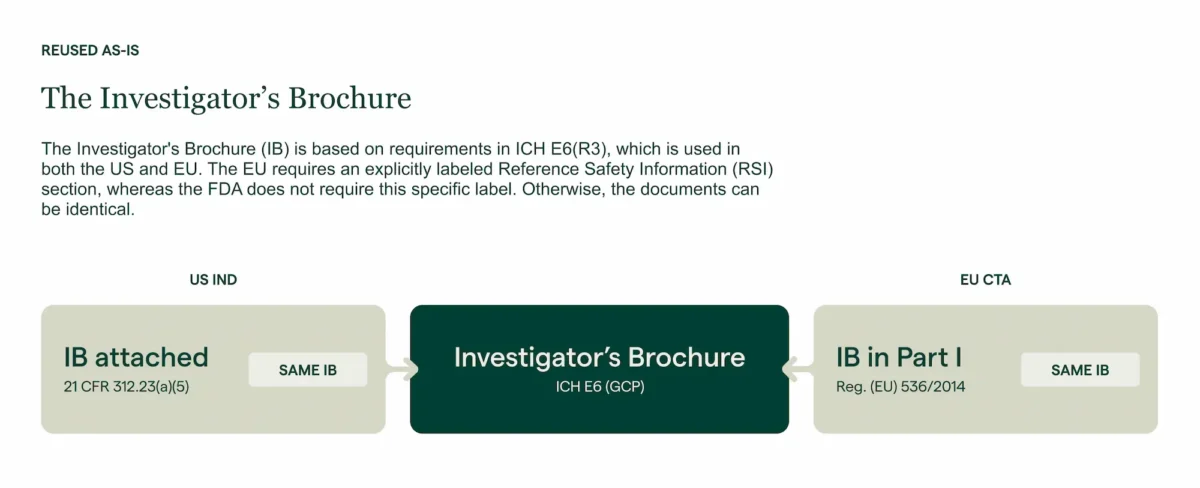
Example 1: The Investigator’s Brochure
An Investigator’s Brochure (IB) is largely the same document, governed under ICH E6 (R3). This document is one of the easiest to re-use across different regions, in part because guidelines are directly laid out in an ICH standard, and in part because the ultimate audience is an investigator, not a regulator. The IB is effectively a pure compilation of knowledge, intended to inform scientifically versus tell a story for approval. However, it still can vary slightly across jurisdictions.
Example 2: Chemistry, Manufacturing and Controls (CMC) Content
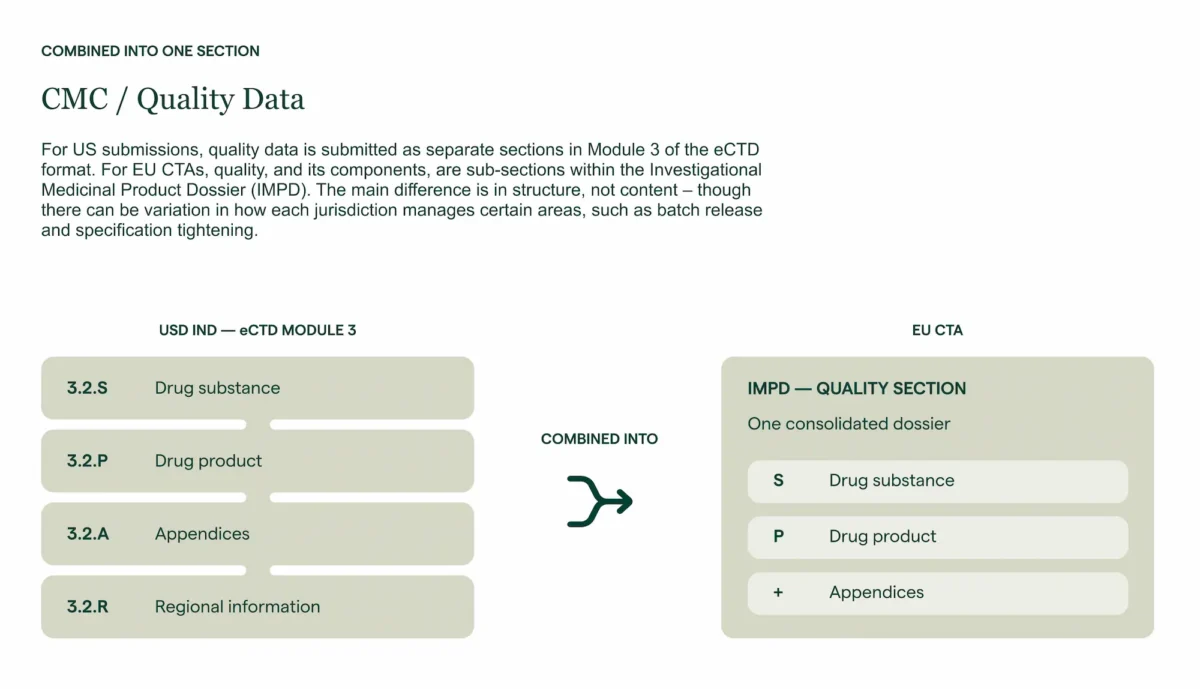
Chemistry, Manufacturing and Controls (CMC) sections are structured differently between the US and Europe. In the US, the CMC information is detailed in Module 3, following ICH standards (M4Q) as part of the eCTD structure. In a CTA in Europe, the format expected by CTIS is the Investigational Medicinal Product Dossier (IMPD). A sub-portion of the IMPD covers quality. While the underlying data still remains the same, the structure is quite different: a hierarchical module structure in the US, a single extensive dossier in the EU. Re-formatting this data in one direction or the other may actually be more difficult than building from scratch, and the task of keeping Module 3 and an IMPD in sync over a decade while a program matures is substantial.
The limits of planning
Given these differences, it’s natural to try to plan for re-usability. Even if the formats are different across jurisdictions, can you structure the documents in each jurisdiction so that re-using them is as simple as possible? Often, yes. But this requires you to know ahead of time what you’re building for, which adds planning overhead and coordination.
Planning reduces the burden, but it doesn’t remove it. Re-use is achievable when source data is structured with portability in mind. The ceiling is administrative content: labeling, patient-facing materials, and submission content that health authorities require in local languages introduce genuine jurisdiction-specific work that templates can’t absorb. The practical implication is that the value of a connected data foundation isn’t measured in documents re-used verbatim — it’s measured in how little has to be rebuilt from scratch each time a new jurisdiction is added to the program.
Building a Submission Infrastructure That Travels
Not every program starts off crossing borders, but most successful drugs are marketed across more than one country. For regulatory teams planning international programs, the question worth asking is not just ‘how do we file in the EU?’ It’s ‘how do we build a program infrastructure that doesn’t charge a rebuild tax every time the program crosses a border?’
That framing shifts the evaluation criteria. A platform that supports global submissions isn’t just about having the right templates — it’s about whether source data is connected, whether verified content travels with the program, and whether the work done today compounds into something useful for every filing that follows.
When every submission is built from the same source data, and every past filing can be cross-referenced for lessons learned and questions answered, the tradeoff between early-stage speed and long-term infrastructure disappears.
The science doesn’t change when a program crosses a border. The submission structure does — and the teams that stop paying the rebuild tax every time that happens are the ones who get to the finish line first.
Weave Bio’s global submission capabilities are available now, including a pre-loaded EU CTA template built to EMA-compliant section hierarchies and a custom template builder for any health authority worldwide.